Most of the stress in a custom build doesn't come from the build itself — it comes from what nobody told you up front.
I've sat across the table from enough homeowners who got burned by their first builder to know the pattern by heart: a price that sounded fixed until change orders started piling up, a start date that slid by months with no explanation, a crew that showed up whenever with whoever. None of that is inevitable. It's just what happens when nobody asked the right questions before signing.
So here are the questions worth asking any builder before you sign anything — organized around the five things that go wrong most often on a custom build. Ask them. Write down the answers.
There's a sixth question worth asking that isn't on most builder checklists, because most builders don't want you asking it: does the person building your home work closely with the person designing it — or are design and construction handled by two separate companies who've never met? That single requirement — a builder and a designer working as one team — is the difference between a design-build company and everyone else. Here's what it actually changes for you.
Under a design-build model, I'm in the room from the first design conversation, not handed a finished set of drawings months later. Design and pre-construction planning happen in parallel instead of one waiting on the other, so ground breaks sooner and nothing sits idle while an architect and a builder go back and forth.
When the designer and builder are the same team, every design decision gets priced against real, current construction costs as you make it — not after the drawings are finished and the bids come back over budget. You find out what something costs while you can still change it, not after you've fallen in love with it.
A detail that lives only on paper is a detail that can get lost between an architect's office and the job site. When one team designs and builds, the person framing your wall is working from the same understanding as the person who drew it — nothing gets lost in translation.
A designer who's never built a house designs for how a photo looks. A builder who's part of the design conversation designs for how you'll actually live in the space — where the morning light hits your coffee spot, how a mudroom needs to work for a family with kids and muddy boots, not just how it renders on a screen.
With two separate companies, a delay or a mistake becomes a finger-pointing exercise between your architect and your builder, and you're the one stuck in the middle relaying messages. With one team, there's one point of contact, one number to call, and nobody to blame but us.
That's the whole idea behind design-build, and it's the model I build every Evolve project on. It's also worth asking any builder you're considering: who drew these plans, and how closely did you actually work with them? See the rest of what sets us apart on our Why Us page, or how the whole build unfolds on Our Process.
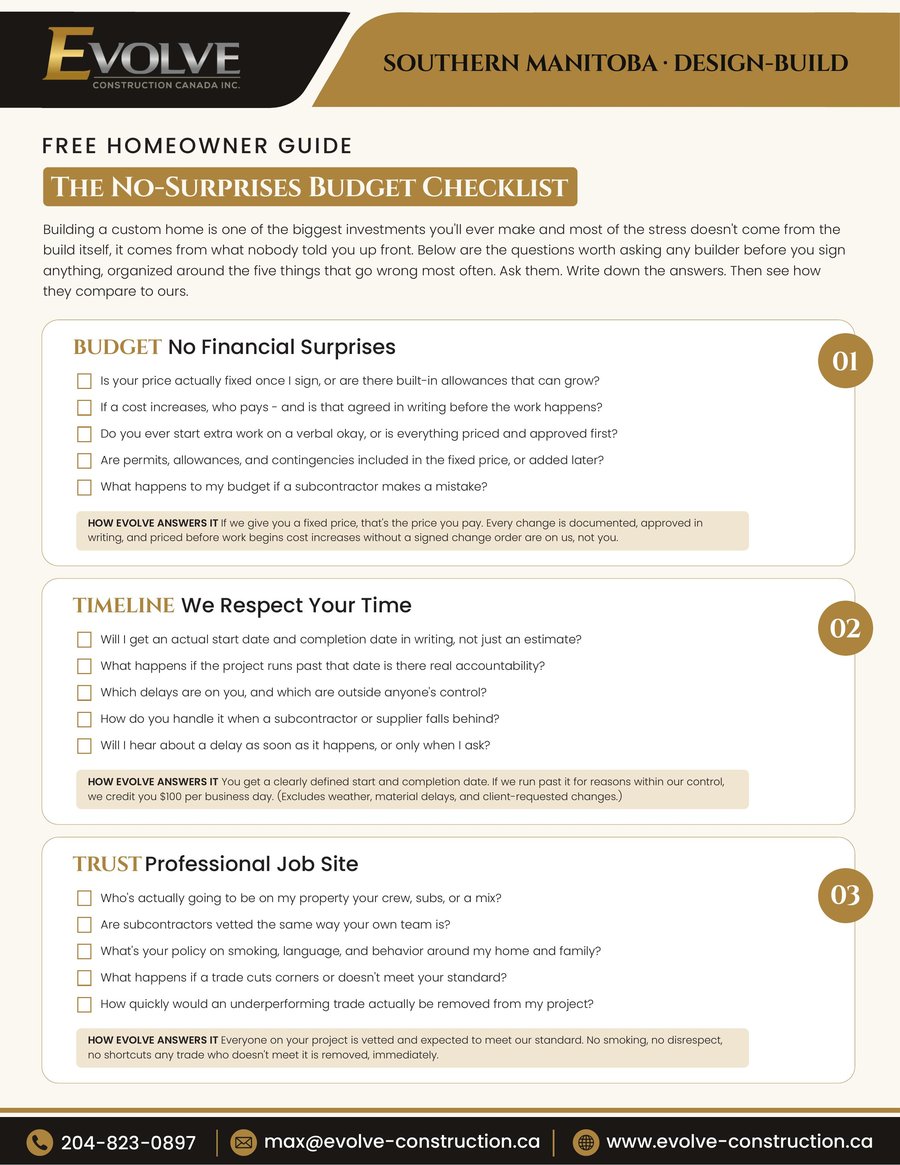
25 questions worth asking any builder before you sign anything — plus how Evolve answers every one.
No pressure, no obligation — just straight answers to every question above.
25 questions worth asking any builder before you sign anything — plus how Evolve answers every one.